The Curious Case of Coos County - Ballot Images

Prologue
In the Curious Case of Coos County - 2020 we outlined the difficulty we went through trying to get ballot images from the County. They wanted over $9,300 for all the images, and when we reduced our request to just the adjudicated ballot images, they reduced the price to $1,582.
An adjudicated ballot is one that the machine can not automatically figure out and needs manual intervention. That election had an increase in adjudication rates from 4% to closer to 10%.
When we produced the money they said they had a hard drive crash and those images were lost. They returned the money and the County Counsel said that since they did not have the records the PRR (public records request) could not be fulfilled.
We told the County that since they lost the images they had to rerun the election to restore the adjudicated ballot images. Federal law stipulates images must be retained for two years. If they don't have them, they have to recreate them. The only way to recreate them is to rerun the election. They have to put the ballots through the machines again so it can determine which of those would be adjudicated.
They disagreed. We filed a lawsuit.
We were doing this pro se, which means without the help of a lawyer. We didn't have that kind of money. This is typical of how larger entities with more money and resources conduct lawfare against smaller, grassroots, efforts. Make it too expensive to fight, and chances are they won't.
The Lawsuit
We could post all the pages of the original complaint, full of mind numbing legalese. We choose to post just the salient points. You can find all the information by getting copies of the court records for 22CV29383.
- Coos County was violating State and Federal election data retention laws because the data they were supposed to have was gone.
- We wanted them to re-scan the ballots to get that data back and be in compliance.
- Since they were responsible for the loss, we should not have to pay.
- We wanted digital copies of the adjudicated ballot images we originally requested.
First Day in Court
The first day in Court the Judge said "If you think Coos Count violated the law, you should have taken this to the District Attorney first.". OK, pro se rookie mistake. We went to the District Attorney.
The DA
We appealed to the District Attorney of Coos County.
The DA stipulated that Federal Law does say that records have to be retained and have not, so the County may be in violation. Since he is not an authorized agent of the Federal Government he can not pursue it.
He then reviewed state election law regarding keeping such a file. He could not find any authorization for an elected District Attorney to order the County to comply with that law.
The DA then reviewed Public Records laws of Oregon and found that he did not have the authority to order a public agency to create or re-create a public record. There were no provisions for records that were lost.
He did, however, say that the County had to allow us to inspect the manually counted ballots that they did have in their possession. The County argued that they did not wish to produce the manually counted adjudicated ballots because to find those ballots would require them to re-scan ALL the ballots.
His order was simply that we shall be allowed to inspect the ballots requested, but it is up to the County to determine how those ballots were to be produced.
The County disagreed.
The lawsuit continued.
The Trial
The trial happened on March 21st, 2023 in the Coos County Courthouse. Judge Stone presided.
At the trial they used screen shots from a running system to try and explain that the election official chooses what is adjudicated. They stated the Clear Ballot system has nothing to do with it.
The Clear Ballot system scans the ballots. It makes a separate image file of the front and the back. It then uses a program to look at those images to figure out which ovals are filled out. If the system can not figure out a ballot because of errors reading the image file, it digitally outstacks those images into an adjudication queue.
True, an election official looks at the images in the adjudication queue to determine voter intent, but that is AFTER the system flags it.
It is ridiculous to think that they have the time to review all 32,000+ ballots to decide which ballots the machine can count, before putting them into the system.
They were showing shots of how they used the system to manually review any ballots the system could not figure out and determine the voters choice. The system had already flagged these ballots when it tried to process them, otherwise they would have nothing to review.
We tried to introduce evidence from the Clear Ballot system administrator manual (see below) explaining that what they were showing the Court was proof that the machine decides what needs to be adjudicated. We downloaded this manual from the Colorado Secretary of State website.
They claimed that a publicly available document was proprietary and could not be used in court. This was after they spent all their time showing screen shots from a running system which is exposing proprietary information. After a short recess, the Judge reluctantly agreed.
Here is the page from the ClearCount Election Administration Guide.pdf manual where they describe how to work with ballot images (cards) that can not be automatically resolved.
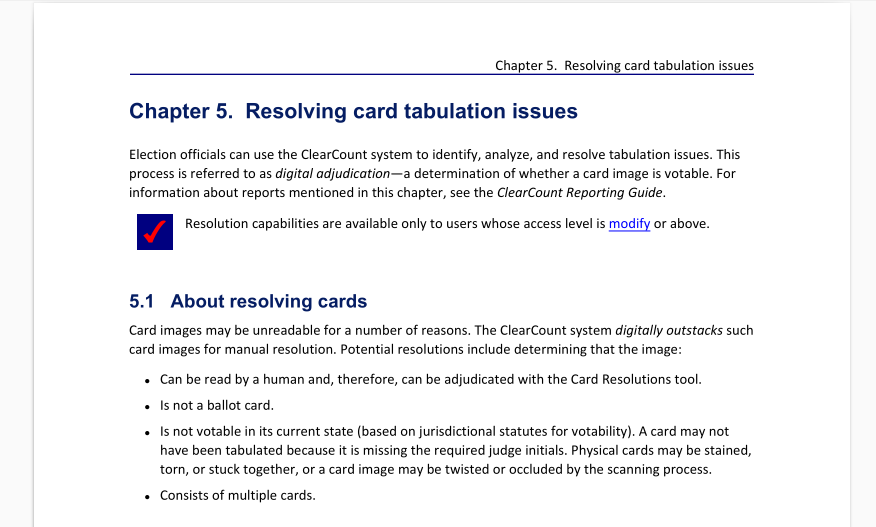
This flies in the face of their sole argument that the ballots to be adjudicated were not decided by the ballot reading software, but done before the ballots were put into the system.
Their lawyer stated that since they could not guarantee the personally adjudicated ballots from the same set of ballots would be the same, it would make no sense to rerun the election to satisfy the request.
To clarify, they said they could not take the same set of paper ballots, the same scanners, the same computers, the same software and the same setup and rerun the election and get the same result.
They testified, in court, under oath, that they could not rerun an election and get the same result.
The judge ruled against us because rerunning the election would not get us the original images of the adjudicated ballots. He did, however, tell them that they had to manually scan ALL the ballots and give us the images.
The Outcome of the Trial
We lost the case. But even with a ruling against us, we did get some positive benefits from it.
- We got them to admit in Court they could not rerun an election and get the same result.
- The Court compelled them to give us ALL the images.
Data Corrupted
In August 2023 they finally produced the ballot images. The delay, they said, was because they had to redact the precinct and ballot style from the ballots for security reasons before they could hand them over to us.
The security premise is based on the idea that if the precinct and ballot style (think sub-precinct) were small enough that we might be able to figure out who voted for what. That doesn't hold true for Coos County as the smallest sub-set of voters is in the hundreds. That does not keep them from using it as an excuse.
Precinct and ballot style, sometimes referred to as card number, are just two small text fields on the ballot. Redacting those would not be a problem, if done correctly. All we wanted to do was read the ballot images, check the ovals, and do our own count of the election results.
If it turned out the same, then it was a huge waste of time. If it did not, then it would indicate other problems.
Instead of redacting the precinct and ballot style with image editing software, they decided to import it into Adobe Acrobat. This converted it into a PDF of the image, bloating the size from about 150k bytes per image to 1M per PDF. When using Acrobat to alter things it keeps a complete log of all the alterations. This further increases the size of the file.
Changing the images into PDFs is normally not an issue. You can't use image processing software like OCR (optical character recognition) to read the images, but you can extract the image from the PDF to do it. It adds a few more steps, but it is not insurmountable.
The problem is they redacted much more than just the precinct and ballot style. Whole chunks of ballot sides were covered up. Some of them had the areas for the ovals covered up or removed.
For example, take a look at the following image...
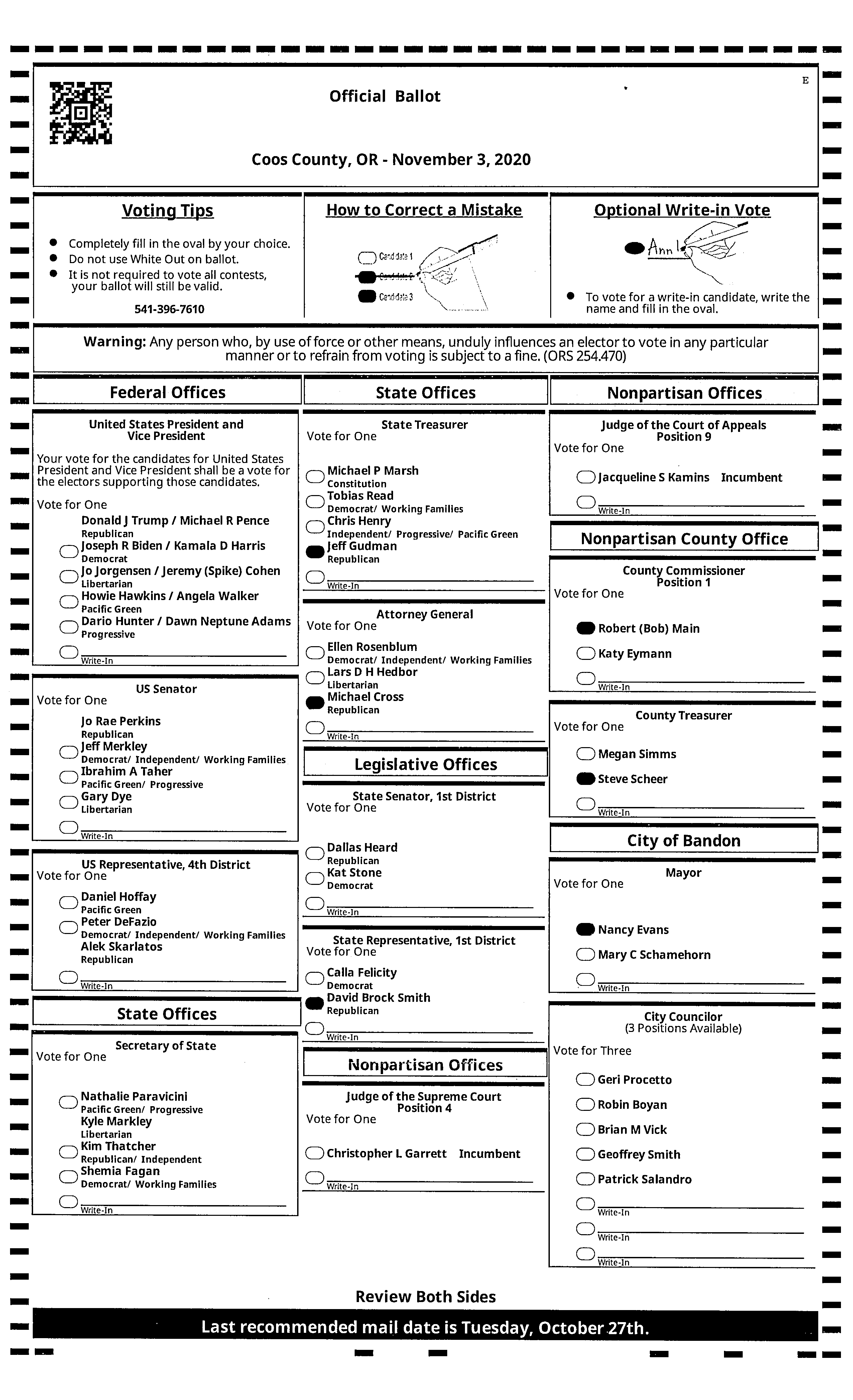
Notice anything odd?
Look at the boxes for President, US Senator, US Representative and Secretary of State. Notice how the ovals are gone. Not unfilled ovals like the other races. Gone. This is not an undervote, where someone does not pick any candidate, this is explicit data corruption.
This was not the only example. There were enough to significantly skew the results.
This meant that no matter what we did, we could NOT make a definitive conclusion.
About That Data
The data we received had adjudicated ballot information from the original election. Here is a screenshot of the first entry.
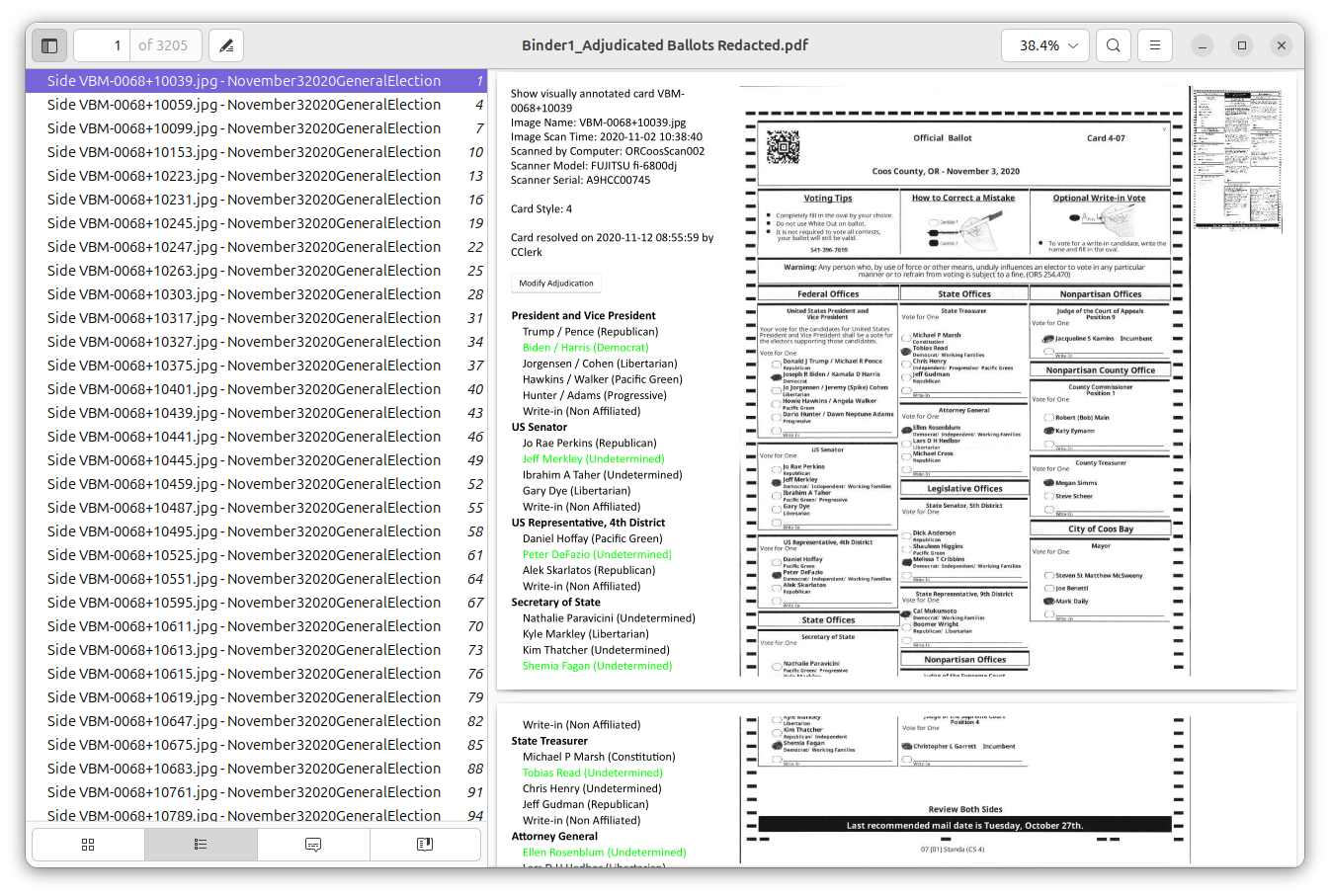
Notice the time stamp on when the card was resolved in the center column. It is from the original election time frame in 2020.
There was also an issue with the file names for the ballot images they sent. The names were just like the file names Clear Ballot would assign when reading from the scanner.
They explicitly said they would not be using Clear Ballot to scan the paper ballots. If they independently scanned the paper ballots they would have had completely different file names according to the manual from the Fujitsu ScandALL PRO software that comes with the scanners.
The whole ruse that the hard drive crash lost the data was false.
Cost to County
A PRR was filed with the County to ask what the suit cost. We asked them to break it down by in-house cost and external counsel cost. This was their response.
Your request seeks the legal costs incurred by Coos County to litigate case #22cv29383 in Coos County Circuit Court. The Office of Legal Counsel does not track its hours in representing the County on legal matters and therefore does not possess records that are responsive to this aspect of your request. As for the costs of representation by Carollo Law Firm, the costs of litigating case #22cv29383 totaled $20,639.10.
Over twenty thousand dollars of taxpayer money spent to keep us from seeing basic election data.
This does not estimate time spent by County Counsel, the District Attorney, the Clerk, the election officials and the person that did redactions.
It would not be unreasonable to say that this time and money could have been put to better use.
Summation
We started this journey to see if we could verify the election results. As stipulated in previous articles, we did not immediately assume there was something wrong. We were curious.
If they were truly transparent this would have been an easy task. It was not.
Why would they spend tens of thousands of dollars, countless hours of County employee time, and years of calendar time, and still deny us access to basic election data?
This is NOT transparency!
The questions we asked have still not been answered.
We are still curious. You should be, too.